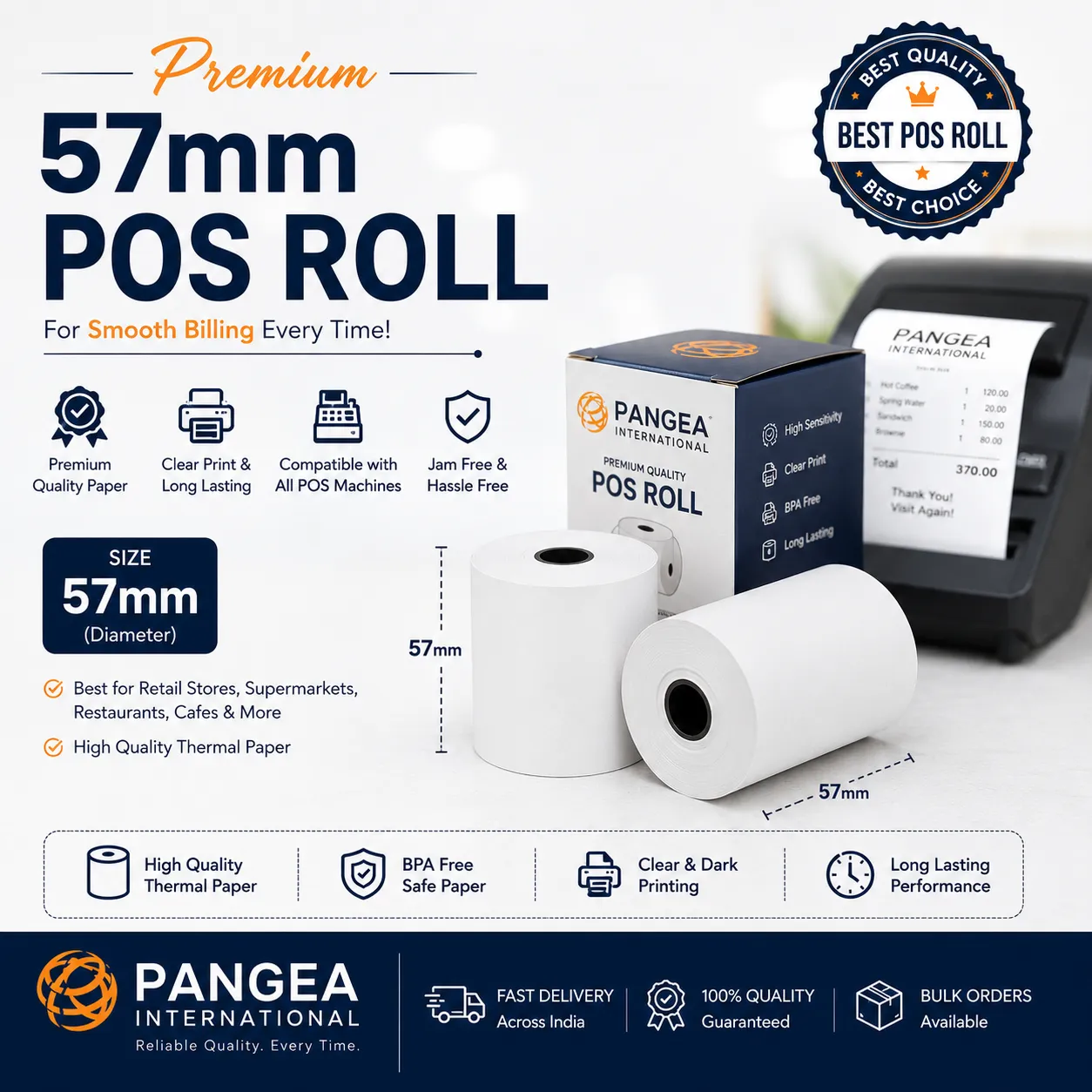
If you run a retail counter, a mobile payment terminal, or a small billing setup anywhere in Gujarat or beyond, chances are you have already handled a 57mm POS roll. It is one of the most common consumables in modern retail, yet most business owners buy it without ever really understanding what makes one roll better than another. Paper that looks identical on the shelf can behave very differently once it is loaded into a printer, and the difference often only shows up weeks later, when text starts fading or a roll refuses to sit properly on the spindle.
This guide walks you through everything worth knowing before your next order, from paper grade and core size to storage, pricing, and GST treatment. We wrote it the way we would explain it to a new customer standing at our counter in Rajkot, in plain language, without the jargon that most supplier catalogues bury the useful information under.
By the end of this article, you will be able to walk into any negotiation with a supplier and know exactly what questions to ask, what specifications actually matter, and why Pangea Retails has become a trusted name for businesses across Rajkot and Gujarat looking to source this product in bulk. We will also cover GST and Input Tax Credit rules relevant to Indian buyers, a real case study from a Rajkot delivery hub, and a full FAQ section addressing the questions we hear most often from first-time and repeat buyers of a 57mm POS roll alike.
What Is a 57mm POS Roll?
A 57mm POS roll is a narrow-width thermal paper roll, measuring 57 millimetres across, used in compact billing machines, portable card swipe machines, handheld printers, and small counter-top receipt printers. Unlike the wider 79mm or 80mm rolls used at supermarket checkout counters, this narrower format is built for devices where space is limited but reliable, fast printing is still essential.
The name itself refers only to the width of the paper. The same nominal width can come in several lengths, core sizes, and paper thicknesses, which is exactly why so many buyers get confused when comparing options from different manufacturers. Two rolls can both be labelled identically on the outer wrapper and still behave very differently once loaded, simply because the core diameter or coating quality differs.
Most portable card machines used by delivery riders, cab aggregators, small kirana stores, and pharmacies are built around this exact width. That is why demand for the 57mm POS roll has grown steadily as digital payments and card machines have become common even in tier-2 and tier-3 Indian cities, not just metros. Every time a customer taps a card or scans a QR code on a handheld device, there is a good chance the printed confirmation slip came from a roll of exactly this size.
It also helps to understand what this product is not. It is not a generic label roll, not a barcode sticker roll, and not interchangeable with the wider format used at large retail counters. Buyers sometimes assume "thermal paper is thermal paper," and that assumption is where most of the printer jams and compatibility complaints we hear about actually originate.
Key Specifications of a 57mm POS Roll
Every roll in this category is defined by five core specifications: width, length, core diameter, paper GSM, and coating type. Getting even one of these wrong can mean a roll that jams, prints faded text, or simply does not fit your machine at all.
|
Specification |
Common Values |
What It Affects |
|
Width |
57mm (fixed) |
Must match your printer slot exactly |
|
Length |
15m, 20m, 25m, 30m, 40m, 50m |
How many receipts per roll, replacement frequency |
|
Core diameter |
12mm, 12.7mm, 13mm, 25mm |
Whether the roll fits the spindle |
|
Paper GSM |
48–70 GSM |
Thickness, durability, and print darkness |
|
Coating |
Top-coated / standard thermal |
Fade resistance and smoothness of print |
|
Outer diameter |
Typically 40–50mm |
Whether the roll fits inside the printer compartment |
A 25-metre length is by far the most widely ordered option in India for handheld card machines, since it balances a reasonable outer diameter with fewer changeovers during a business day. Businesses with heavier print volumes, such as quick-service restaurants or busy delivery hubs, often move up to a 30m or 40m length to reduce the number of times staff need to reload the machine mid-shift.
Outer diameter deserves more attention than it usually gets. A longer roll packed onto the same core naturally has a larger outer diameter, and some compact printer compartments simply cannot accommodate anything beyond a certain size. Before ordering a longer length purely to reduce changeover frequency, it is worth measuring your printer's compartment or checking the manual, since a roll that is too large to close the lid properly defeats the purpose entirely.
Why Businesses Are Switching to This Format
Space efficiency is the biggest reason retailers, delivery services, and mobile vendors prefer this narrower roll over wider formats. A smaller width means a smaller printer, which matters enormously for anyone working out of a bag, a bike, or a compact counter where every centimetre of space is already accounted for.
Cost is another factor. A narrower roll uses less raw paper per metre than an 80mm roll, so unit pricing is typically lower even when comparing similar lengths. For businesses printing thousands of receipts a month, that difference adds up quickly, and over a full year it can represent a meaningful line item in overall consumables spending.
Compatibility is the third reason, and arguably the most decisive one. Nearly every handheld card swipe machine sold in India today, from major payment gateway providers, ships with a printer designed around this exact width standard. Switching to any other width simply is not an option unless the business replaces the hardware itself, which makes the paper choice effectively pre-determined by the device.
Finally, availability plays a role that is easy to underestimate until it becomes a problem. Because this format is manufactured at such scale across the country, it is generally easy to source consistently, which matters enormously for any business that cannot afford to run out of receipt paper during peak billing hours, especially during festive seasons when transaction volumes spike sharply.
Reliability of supply, in fact, is often the deciding factor for repeat buyers more than price. A supplier that is two rupees cheaper per roll but occasionally runs out of stock for two weeks at a time ends up costing a business far more in lost billing time and emergency purchases from unfamiliar vendors.
57mm POS Roll vs 79mm/80mm POS Roll: Which One Do You Need?
This is one of the most frequent questions we get from new customers of Pangea Retails, and the honest answer is that it depends entirely on your printer, not your personal preference or what a neighbouring business happens to use.
|
Factor |
57mm POS Roll |
79mm/80mm POS Roll |
|
Typical use case |
Handheld card machines, taxi meters, mobile POS |
Countertop billing, supermarkets, restaurants |
|
Printer size |
Compact, portable |
Larger, desk-mounted |
|
Receipt content |
Short - amount, date, reference number |
Detailed - itemised bills, GST breakup, logos |
|
Paper cost per roll |
Lower |
Higher |
|
Common industries |
Retail delivery, cab aggregators, courier, salons |
Grocery stores, restaurants, pharmacies, malls |
|
Typical roll life per shift |
Higher turnover on short receipts |
Fewer changeovers due to detailed, longer prints |
If your printer's manual specifies a 57mm width, no other size will physically load correctly, regardless of price or paper quality on offer. This is why we always recommend checking the machine's manual or the packaging of the previous roll before ordering a bulk batch of any width.
Some businesses run mixed printer fleets, for instance a supermarket with a countertop billing printer using the wider format alongside a handheld card machine at the delivery counter using the narrower one. In these cases, it is worth maintaining separate, clearly labelled stock for each width, since mixing up boxes in a stockroom is a surprisingly common and entirely avoidable source of downtime.
Is Your 57mm POS Roll BPA-Free? Why It Matters
Thermal paper is coated with a heat-sensitive layer that reacts with the printer head to form text, and older formulations of this coating relied on Bisphenol-A (BPA), a chemical now linked to health concerns with repeated skin contact over long periods. Every roll sold by Pangea Retails under this specification is manufactured using BPA-free thermal coating.
This matters for two groups in particular. Cashiers and delivery staff who handle receipts dozens or hundreds of times a day face the highest exposure risk, and choosing a BPA-free option directly reduces that exposure across an entire workforce over months and years of daily handling. It also matters for businesses in food service, pharmacy, and healthcare, where regulatory scrutiny around chemical safety is tightening across many state and national guidelines, and customer expectations around safety are rising too.
When comparing suppliers, always ask for a BPA-free certification or lab test report before committing to a large order. A reputable manufacturer will have this documentation ready without hesitation, and Pangea Retails provides it on request for every production batch, along with details of the coating formulation used.
It is worth noting that BPA-free does not automatically mean chemical-free in every sense; some manufacturers substitute BPA with alternative developers such as BPS, which carries similar concerns among some researchers. When sourcing this product for a health-conscious business, ask specifically what the coating has been substituted with, rather than accepting "BPA-free" as the end of the conversation.
Understanding GSM and Paper Grade
GSM, or grams per square metre, tells you how thick and heavy the paper is. Rolls in this category typically range from 48 GSM on the lighter end to around 70 GSM on the heavier, premium end, with most everyday retail use sitting comfortably in the 55-60 GSM band.
Lower GSM paper is lighter and slightly cheaper, which suits businesses with high receipt turnover and short storage requirements, such as quick-service counters where the customer glances at the receipt once and discards it. A 48 GSM roll prints quickly and is more than adequate for same-day or short-term receipts that customers rarely keep for more than a few hours.
Higher GSM paper, closer to 65-70 GSM, is thicker, resists tearing better, and generally holds print quality longer during storage. Pharmacies, clinics, and any business where receipts may need to be referenced weeks or months later, such as for warranty claims or insurance reimbursement, should lean toward a heavier grade for exactly this reason.
Paper grade also affects print darkness in ways that are easy to underestimate until you compare two rolls side by side. Cheaper, uncoated thermal stock can produce grey or patchy text, especially in humid conditions common across coastal Gujarat and much of western India during monsoon months. A well-coated roll maintains crisp, dark, legible text even after weeks of storage, which is why sourcing from an established manufacturer matters more than chasing the lowest quoted price per carton.
There is also a practical middle ground many businesses overlook: ordering a slightly heavier GSM than strictly necessary is often cheaper in the long run than dealing with customer disputes over illegible receipts, particularly for higher-value transactions where a faded receipt can complicate a refund or exchange.
Environmental Considerations and Sustainability
Sustainability is becoming a genuine purchasing factor for this category, not just a marketing line on a product page. Standard thermal paper is difficult to recycle through conventional paper recycling streams because of its chemical coating, so a growing number of businesses are asking suppliers about disposal and sourcing practices before placing large orders.
Look for a 57mm POS roll manufactured from responsibly sourced base paper, ideally from suppliers who can speak to their pulp sourcing and manufacturing waste practices rather than offering a vague sustainability claim without any detail behind it. Pangea Retails works with paper stock sourced through accountable supply chains and is happy to discuss sourcing specifics with business customers who ask.
Some businesses are also switching to slightly heavier GSM options specifically because a thicker, better-coated roll produces fewer misprints and reprints, which indirectly reduces overall paper waste across a billing counter or delivery fleet compared to using the thinnest, cheapest paper available and reprinting failed receipts repeatedly throughout the day.
Where Is the 57mm POS Roll Used Across Industries?
The versatility of this format is best understood by looking at where it actually shows up in daily commercial life across very different sectors.
-
Retail and delivery: Handheld card machines used by delivery executives and last-mile logistics partners almost universally run on this exact roll width, printing short confirmation slips at the customer's doorstep.
-
Ride-hailing and taxis: In-vehicle printers for fare receipts and taxi meters are built around this width, since dashboard-mounted printers have limited physical space.
-
Salons and small services: Compact billing counters in salons, spas, and repair shops favour this format for its lower footprint on a small reception desk.
-
Healthcare: Pharmacies and diagnostic centres use it for prescription slips and short billing receipts that need to be quick to print between patients.
-
Events and ticketing: Portable ticket printers at events, parking lots, and toll booths commonly use this exact size for on-the-spot printing.
-
Banking: Many ATMs and micro-ATM terminals, particularly in semi-urban and rural areas, are designed around this width standard for transaction slips.
-
Field service and logistics: Technicians and delivery agents carrying portable Bluetooth printers for on-site invoicing rely on the same narrow format for portability.
Each of these use cases has slightly different priorities, whether it is print speed, paper length, or fade resistance, but all of them depend on a dependable, correctly specified roll to function without interruption during business hours.
How to Choose the Right 57mm POS Roll for Your Business
Start with your printer's manual rather than the box the paper comes in. Every card machine or billing printer specifies an exact width, core size, and maximum roll diameter, and any roll you buy must match all three, not just the width printed on the wrapper.
Next, estimate your daily receipt volume honestly, based on actual transaction counts rather than a rough guess. A business printing 50-100 receipts a day is well served by a 20-25m roll, while a high-volume delivery hub or restaurant may need 30-40m rolls to avoid frequent mid-shift changes that pull staff away from customers.
Then decide on paper grade based on how long receipts need to remain legible after printing. If your customers or your own accounts team need to reference bills weeks later for warranty claims or reconciliation, choose a higher GSM option rather than the cheapest one available on a price list.
Consider seasonal humidity too. Businesses operating in coastal or high-humidity regions of Gujarat sometimes find that a mid-range GSM with a slightly better top coating performs more consistently through monsoon months than an ultra-thin, budget-grade alternative.
Finally, always verify BPA-free status and ask for a sample before committing to a bulk order. A single test roll run through your actual printer tells you more about fit and print quality than any specification sheet ever will, and Pangea Retails is happy to arrange samples for exactly this reason before any large commitment is made.
Common Mistakes Businesses Make When Buying a 57mm POS Roll
Many businesses order purely by price, without checking core size, and end up with paper that fits the width slot but wobbles or jams because the core diameter does not match the spindle inside their specific printer model.
Others buy in very small, frequent batches, paying higher per-unit prices and increasing delivery costs, when a single larger order of the same specification would have been considerably cheaper across a full quarter once logistics costs are factored in.
A less obvious mistake is ignoring storage conditions entirely. Every roll in this category is sensitive to heat, direct sunlight, and humidity, all of which can fade printed text well before the paper itself physically degrades. Receipts stored near a window or above a heat-generating device often become unreadable within weeks, sometimes days in extreme summer heat.
Some buyers also assume that a slightly wrong core size can simply be "forced" onto the spindle. This often damages the printer's feed mechanism over repeated use, turning a cheap paper mistake into an expensive hardware repair bill.
Finally, some buyers skip asking about BPA-free certification altogether, assuming all thermal paper is functionally identical. As covered earlier, this is an increasingly important differentiator, and a careful buyer treats it as a standard question for every quote requested from any supplier, not an optional extra.
Cost, Bulk Buying, and GST/ITC Guidance in India
For Indian retailers and distributors, thermal paper products including this category generally fall under HSN code 4811, and GST rates on thermal and coated paper products typically apply at the standard slab applicable to paper-based consumables. Businesses registered under GST can claim Input Tax Credit (ITC) on purchases made for business use, provided the purchase is backed by a valid GST invoice from a registered supplier such as Pangea Retails.
Buying in bulk consistently reduces per-unit cost, often more than businesses expect when they first request a quote. An order placed in cartons of 100 rolls typically costs noticeably less per unit than ten separate small orders, once freight and handling costs across multiple deliveries are factored into the comparison.
For multi-location retailers or franchise networks, consolidating purchases into a single quarterly order across all outlets often produces the strongest pricing, since suppliers can plan production runs and logistics more efficiently around a predictable, larger commitment rather than scattered ad-hoc orders.
Always request a proper GST-compliant tax invoice when purchasing this product for business use, both to remain compliant with tax regulations and to ensure ITC eligibility is not lost due to missing or incomplete documentation. Pangea Retails issues GST invoices with every order, whether the customer is a single kirana store ordering a handful of rolls or a distributor sourcing pallet-scale quantities for onward resale.
It is worth keeping a simple internal record of GST invoices tied to consumable purchases like this one, since during an audit, missing paperwork for even low-value, high-frequency items can create disproportionate friction relative to the actual amount involved.
Case Study: How a Rajkot Delivery Hub Cut Consumables Cost by Switching Its Supplier
A mid-sized last-mile delivery hub operating out of Rajkot was sourcing its handheld printer paper from three different local vendors, largely because no single supplier could guarantee consistent stock through the year. This led to inconsistent paper quality, occasional printer jams from mismatched core sizes, and higher effective pricing due to small, frequent, reactive orders placed whenever stock ran low unexpectedly.
After consolidating its entire requirement with Pangea Retails and switching to a single standardised 25m specification across all of its handheld machines, the hub reported a reduction in per-unit cost of close to 18% within the first quarter, driven mainly by bulk pricing and elimination of emergency small-batch purchases from whichever local shop happened to have stock.
Just as importantly, printer jam-related downtime dropped sharply once every device used the exact same specification, since staff no longer had to troubleshoot machines loaded with mismatched core sizes sourced from three different vendors with three slightly different production standards. Delivery riders reported fewer mid-route printer failures, which in turn reduced customer complaints about missing payment confirmation slips.
The business now places a single monthly bulk order timed to its billing cycle and has not experienced a stock-out since switching, even during the high-volume festive season when transaction volumes across the hub roughly doubled compared to regular months. The finance team also noted that consolidated GST invoicing from a single supplier simplified its monthly reconciliation process considerably, compared to matching invoices from three separate small vendors each month.
This case reflects a pattern we see repeatedly across Rajkot and Gujarat: businesses that treat their 57mm POS roll sourcing as a strategic, planned purchase rather than a reactive one tend to see measurable savings within a single quarter, not just in unit price but in staff time and printer maintenance costs as well.
How to Store and Handle This Product for Longer Shelf Life
Store every roll away from direct sunlight, ideally in its original packaging until use, since UV exposure degrades the thermal coating even before the roll is ever loaded into a printer. A cool, dry storage room works far better than a shelf near a window or under direct fluorescent lighting for extended periods.
Avoid stacking rolls near heat sources such as printers, photocopiers, or direct electrical equipment, since heat alone can pre-activate parts of the thermal coating and cause faint grey patches even before printing begins, wasting usable paper before it reaches a customer.
Humidity control matters just as much as temperature. In parts of Gujarat where monsoon humidity rises sharply for several months, storing stock in sealed containers or a climate-controlled stockroom noticeably extends how long a roll retains crisp print quality once finally loaded and used.
Once printed, keep important receipts away from lamination containing PVC, and avoid prolonged contact with plastic folders that can accelerate fading over time through a chemical reaction with the thermal coating. For businesses that must retain receipts for accounting or warranty purposes, photocopying onto plain paper or scanning digitally remains the most reliable long-term archival solution, since even well-stored thermal print will fade eventually.
Signs It Is Time to Replace Your Current Supplier
If your current 57mm POS roll supplier frequently runs out of stock, forcing your team to source emergency small batches from unfamiliar local shops, that recurring disruption alone often costs more in staff time and inconsistent paper quality than any price advantage the supplier originally offered.
Frequent printer jams across multiple machines, especially after a recent batch change, are a strong signal that core diameters or outer roll dimensions are drifting from what your printers actually require, even if the width label on the packaging looks correct.
Fading receipts within days rather than weeks, particularly during warmer months, usually points to an inconsistent or lower-than-advertised paper grade, and is worth raising directly with your supplier alongside a request for documentation on GSM and coating type.
Finally, if your supplier cannot readily provide a GST-compliant invoice or BPA-free documentation on request, treat that as a warning sign regardless of how competitive their pricing appears on paper, since both issues can create real compliance and safety exposure down the line.
Where to Buy a 57mm POS Roll in India: Why Pangea Retails
Pangea Retails supplies this product manufactured to consistent width, core, and GSM specifications, tested for BPA-free compliance, and backed by GST-compliant invoicing for every order placed. Whether you need ten rolls for a single counter or a pallet-scale monthly supply for a distribution network spanning multiple cities, the same specification and quality standard applies across every production batch.
For businesses across Rajkot, Gujarat, and the wider Indian market, working with a manufacturer directly rather than a reseller means fewer middlemen, more predictable lead times, and pricing that improves meaningfully as order volume grows over successive quarters. You can browse current stock of the 57mm x 25 Mtr POS Roll directly on the Pangea Retails shop page, alongside other widths such as the 79mm x 25 Mtr POS Roll for businesses running mixed printer fleets across a single site.
If you are still deciding between formats for a growing business, our related guide on choosing between 79x50 and 56x25 rolls breaks the decision down in more detail, and our piece on BPA-free safety covers the health considerations in greater depth for buyers in food service and healthcare. For readers comparing local manufacturers before placing a large order, our guide to top POS roll manufacturers in Rajkot is a useful next read, alongside our broader overview of choosing POS rolls for general guidance across all common widths.
Frequently Asked Questions About the 57mm POS Roll
What size printer does a 57mm POS roll fit?
It fits any handheld card machine, portable receipt printer, or compact billing device whose manual specifies a 57mm paper width and a matching core diameter, typically 12mm or 12.7mm, so always confirm both figures rather than the width alone.
Is a 57mm POS roll the same as thermal paper?
Yes, this is a specific width of thermal paper, coated with a heat-sensitive layer that prints when heated by the printer head, rather than relying on ink cartridges or toner like traditional printers.
How long does one 57mm POS roll last?
A standard 25-metre roll typically prints between 200 and 300 short receipts, depending on receipt length and print density, though high-detail receipts with logos will reduce that count somewhat.
Is a 57mm POS roll safe to handle daily?
A BPA-free option, such as the ones supplied by Pangea Retails, is formulated without Bisphenol-A, making it a considerably safer choice for staff who handle receipts repeatedly throughout an entire working day.
Can I claim GST input tax credit on a 57mm POS roll purchase?
Yes, GST-registered businesses can typically claim Input Tax Credit on this purchase when bought for business use, provided it is supported by a valid GST invoice from a registered supplier.
What is the difference between 57mm and 80mm POS rolls?
The narrower format is used mainly in handheld or portable devices, while the 80mm option is wider and designed for countertop printers in supermarkets and restaurants that print detailed, itemised bills with logos.
Where can I buy a 57mm POS roll in bulk in Gujarat?
Pangea Retails supplies this product in bulk across Rajkot and Gujarat, with GST-compliant invoicing and consistent specifications for businesses of any order size, from single-counter retailers to multi-location distributors.
Final Thoughts
Choosing the right 57mm POS roll is less about finding the cheapest option on a price list and more about matching specification, paper grade, and supplier reliability to how your business actually uses the printer day to day. Whether you run a single billing counter or manage consumables across an entire delivery fleet spread across a city, the fundamentals covered in this guide, width, core size, GSM, BPA-free coating, and GST compliance, apply equally to every buyer.
Pangea Retails has built its supply of this product around exactly these fundamentals, so that businesses across Rajkot and Gujarat can order with confidence rather than guesswork or trial and error. If you are ready to place an order or simply want a sample before committing to bulk quantities, our team is available to help you choose the right specification for your specific printer and business volume.