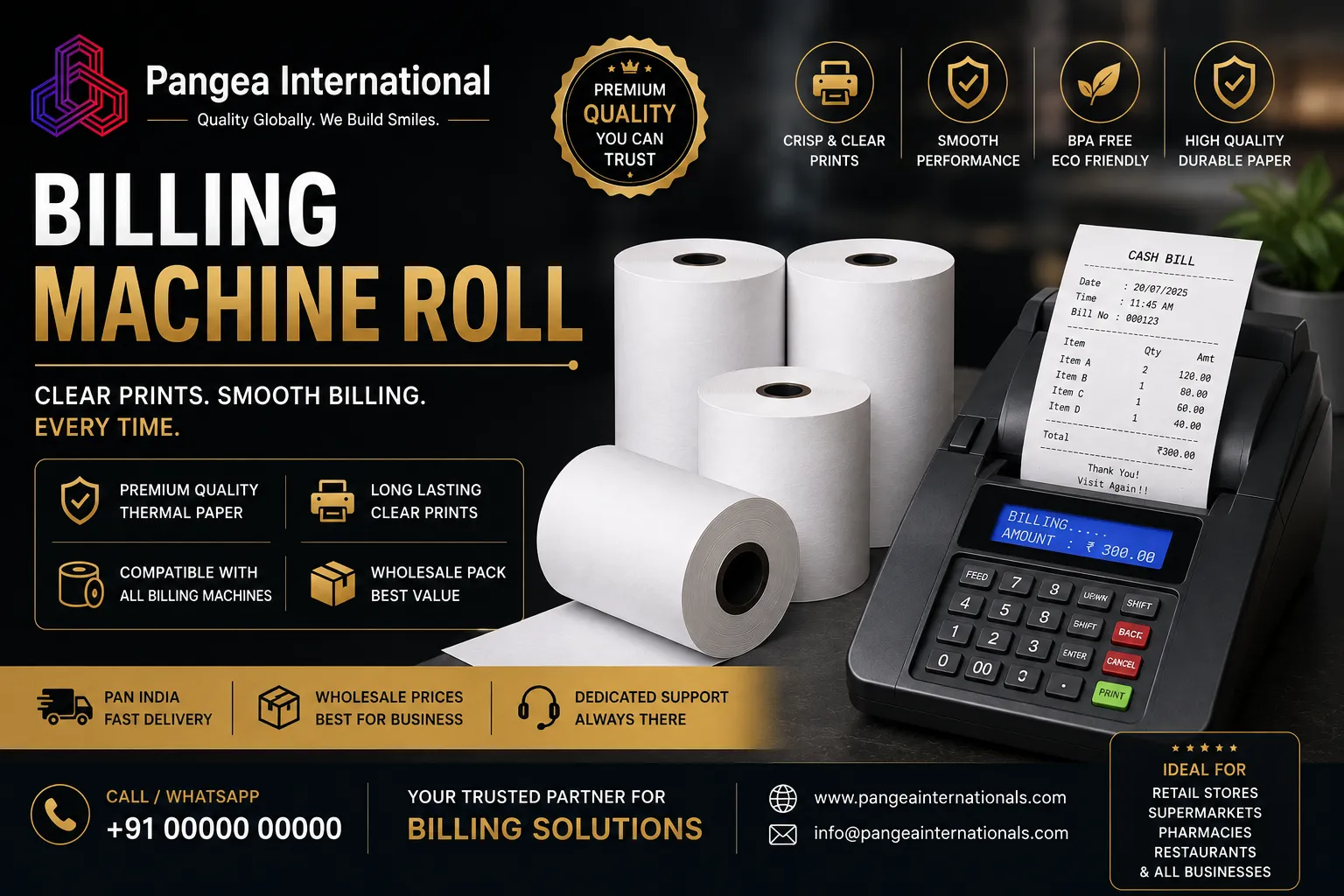
Ever had a customer stand at your counter, card already tapped, transaction approved, and then... nothing? No receipt. Because the billing machine roll ran out, or worse, it was the wrong size and jammed halfway through printing, right when the queue behind them was longest. If you have ever felt that specific flavour of frustration, you already understand why this guide exists.
This paper is one of those products that nobody thinks about until it stops working. It sits quietly inside your printer, doing its job, until one day it doesn't, and suddenly your entire counter grinds to a halt. We have spent years supplying this exact product to retailers, restaurants, pharmacies, and delivery businesses across Rajkot and Gujarat, and if there is one thing we have learned, it is this: most billing headaches trace back to a paper decision nobody thought carefully about.
Maybe you've experienced this yourself already. Maybe you're reading this precisely because your printer jammed this morning, or last week, or one too many times this month, and you finally decided to figure out why. Either way, you're in the right place. This isn't a sales page dressed up as a guide; it's the same information we'd walk a customer through on a phone call, just written down so you can read it at your own pace and come back to it whenever you need it.
So let's fix that. By the end of this guide, you will know exactly what a billing machine roll is, how to pick the right one for your printer and your business, what mistakes to avoid, and how to buy smart so you are never standing at your counter apologising to a customer for a paper problem again.
What Exactly Is a Billing Machine Roll?
Let's start simple. A billing machine roll is the roll of paper loaded into your billing printer, cash register, or POS terminal that produces the printed receipt handed to your customer at the end of a transaction, the small paper slip that confirms a sale actually happened, on record, for both sides of the counter. Whether you run a supermarket, a pharmacy, a restaurant, or a mobile delivery service, chances are this exact product is involved somewhere in how you close out a sale.
Here's the thing most people don't realise: not all rolls are created equal. Some are thermal, reacting to heat from the printer head with no ink involved at all. Others are plain bond paper, printed using an impact or dot-matrix mechanism. A few are carbonless, designed to create a duplicate copy without a single drop of ink or toner. Each type suits a different kind of machine, and using the wrong one is a bit like trying to fit a square peg into a round hole; it might look close enough, but it simply will not work properly.
Think of this product the way you'd think about fuel for a car. Put the wrong fuel in, and the engine might sputter, stall, or just refuse to start. Put the right roll into your printer, matched precisely to its specifications, and everything runs the way it should, quietly and reliably, transaction after transaction.
Why Choosing the Right Billing Machine Roll Matters More Than You Think
You might be asking yourself: it's just paper, right? How much difference can it really make? Fair question. Let's talk numbers for a second.
India's retail payment ecosystem has been expanding at a genuinely remarkable pace. According to RBI data, the number of point-of-sale terminals deployed across the country grew by close to a quarter in a single financial year, crossing the one-crore mark nationally. Every one of those terminals needs reliable receipt paper to actually complete the transaction the customer sees. That is a lot of receipts, and a lot of opportunity for something to go wrong if the paper behind the scenes isn't right.
Here's what a poorly chosen roll actually costs you, beyond the price on the invoice:
-
Lost time: Every jam means a staff member stops serving customers to fix a printer, and a queue starts forming behind the one person who's stuck.
-
Lost trust: A faded or unreadable receipt looks unprofessional, and in industries like pharmacy or automotive service, a legible billing machine roll can matter for warranty and compliance reasons too.
-
Lost money: Emergency small-batch purchases from whichever local shop has stock cost more per unit than planned, bulk orders, sometimes considerably more.
-
Lost equipment life: Gritty, inconsistent paper wears down an expensive print head faster than good-quality stock, quietly shortening the life of hardware that isn't cheap to replace.
None of these costs show up as a single line item on any invoice, which is exactly why they're so easy to overlook until they've quietly added up to something significant over a full year of operation.
The Hidden Cost of a Bad Billing Machine Roll
Here's an analogy that tends to land with business owners: buying a cheap, mismatched roll is a bit like buying cheap tyres for a delivery van. You save a little upfront, but you pay it back, and then some, in breakdowns, delays, and the occasional very annoyed customer.
We have talked to shop owners who assumed all receipt paper options were interchangeable, only to discover months later that their print head had worn out faster than expected because the paper coating was inconsistent, gritty, and abrasive batch after batch. That is not a hypothetical; it's a pattern we see often enough that it is worth calling out clearly right at the start of this guide.
A replacement print head isn't a small expense either, often running into thousands of rupees once you factor in service call charges, and that's before counting the lost billing time while the printer sits out of action waiting for a technician.
Types of Billing Machine Roll You'll Encounter
Not every roll in this category works the same way. Broadly, you will run into three categories, and knowing which one your machine actually needs is step one before you spend a single rupee.
Thermal Billing Machine Roll
This is, by far, the most common type in modern retail. A thermal roll in this category uses a heat-sensitive coating that reacts to the printer head, producing text with zero ink, toner, or ribbon involved. It is fast, quiet, and the reason your handheld card machine or supermarket printer can churn out a receipt in under a second.
The tradeoff? Thermal prints fade over time, especially with heat or sunlight exposure, so this type isn't ideal for records you need to keep legible for years.
Carbonless (Two-Ply) Billing Machine Roll
Some businesses, particularly those needing a duplicate copy for their own records alongside the customer copy, use a carbonless billing machine roll. Pressure from the printer head transfers the image from the top sheet to the layer below, creating an instant copy without any ink cartridge at all.
Restaurants and service centres often prefer this style of paper because it gives them a retained duplicate without the extra step of photocopying every single receipt manually.
Plain Bond Billing Machine Roll
Older cash registers and some dot-matrix billing systems still use a straightforward plain paper roll, printed with an ink ribbon rather than heat or pressure. It is less common today, but if you are running legacy equipment, this is likely still what your machine expects, and swapping in a thermal roll simply will not print at all.
Billing Machine Roll Sizes: A Quick-Reference Chart
Width is non-negotiable. Get this wrong, and no amount of quality elsewhere in the paper will save you, because it simply will not fit inside your machine.
|
Width |
Typical Machines |
Common Lengths |
|
57mm |
Handheld card machines, taxi meters, mobile billing apps |
15m, 20m, 25m, 30m |
|
79mm/80mm |
Countertop billing printers, supermarkets, restaurants |
40m, 50m, 60m, 80m |
|
76mm |
Older cash registers, select legacy POS models |
30m, 40m |
|
112mm |
Kitchen order printers, specific banking terminals |
25m, 30m |
Before you order a single roll, check your printer's manual, or better yet, measure the old roll directly. A five-minute check now saves you the headache of a box of unusable stock sitting in your storeroom later.
How to Choose the Right Billing Machine Roll for Your Business
Let's get practical. Here's the exact process we walk customers through when they call us unsure of what to order, whether they're opening their very first counter or standardising paper across a dozen outlets.
Match It to Your Machine First
This sounds obvious, but it is the single most common mistake we see. Your printer, not your preference, dictates the width, core diameter, and maximum roll size you need. Check the manual, or measure the existing roll's width, outer diameter, and the hole in the middle (the core) before ordering anything.
Think About Your Daily Volume
Ask yourself: how many receipts does your counter print on an average day? A shop doing under 100 transactions daily is fine with a shorter, 15-20 metre roll. A busy restaurant or delivery hub printing several hundred receipts a shift will burn through short rolls fast, meaning more interruptions to reload, so a 30-40 metre option makes more sense.
Don't Ignore GSM and Coating Quality
GSM, or grams per square metre, tells you how thick and durable the paper is. A lighter, 48-50 GSM roll suits high-turnover counters where receipts are glanced at once and binned within minutes. Heavier 60-70 GSM options resist tearing better and hold print quality longer, which matters if customers or your own accounts team need to reference a receipt weeks later for a warranty claim, an exchange, or a reconciliation query.
Here's a simple checklist you can run through before placing any order:
-
[ ] Confirm width matches your printer's exact specification
-
[ ] Confirm core diameter fits your spindle without wobbling
-
[ ] Check maximum outer roll diameter against your printer's compartment
-
[ ] Decide on GSM based on how long the receipt needs to stay legible
-
[ ] Ask whether the coating is BPA-free, especially for food, health, or export-facing businesses
-
[ ] Request a sample before committing to a bulk order
-
[ ] Confirm GST-compliant invoicing is available
Real-World Examples: Billing Machine Roll Use Across Industries
It helps to see how different businesses actually use this paper day to day, because the "right" choice really does depend on context.
-
Supermarkets and grocery stores: High receipt volume, detailed itemised bills, usually a wider 80mm billing machine roll on a countertop printer.
-
Restaurants and cafes: Both a customer-facing receipt roll and, often, a separate kitchen order printer running the same category of paper.
-
Pharmacies: Prescription slips and billing receipts where legibility over several weeks genuinely matters, pushing toward heavier GSM stock.
-
Delivery and logistics: Riders carrying handheld printers rely on a compact 57mm billing machine roll that fits in a bag without adding bulk.
-
Salons and small services: Compact billing counters where a narrow, economical roll keeps both the printer and the paper budget small.
-
Toll plazas and parking: High-speed, high-volume printing where a dependable, consistent billing machine roll prevents costly downtime during peak traffic hours.
Each of these businesses is solving a slightly different problem, but all of them share the same underlying need: receipt paper that fits, prints clearly, and doesn't run out at the worst possible moment.
It's worth noticing something else in that list too: the businesses with the highest transaction volumes, supermarkets, toll plazas, delivery hubs, are also the ones with the least tolerance for downtime. If you're running a low-volume boutique printing twenty receipts a day, a paper jam is an annoyance. If you're running a toll plaza processing a vehicle every few seconds during rush hour, the same jam becomes a genuine operational problem with a queue of frustrated drivers to show for it. Match your urgency about getting this right to your actual transaction volume, and you'll rarely go wrong.
Case Study: How One Rajkot Retailer Solved Its Billing Machine Roll Headache
A mid-sized apparel retailer with three outlets across Rajkot came to us with a familiar complaint: printer jams, inconsistent print darkness, and staff constantly calling the head office asking which supplier to reorder from that week.
The root issue? Each store had been sourcing its receipt paper independently, from whichever local vendor happened to be closest, with zero standardisation on GSM, core size, or even width across the three locations. One store's printer was loaded with a core size that didn't quite match its spindle, causing wobble and misfeeds several times a day.
We worked with the retailer to standardise on a single billing machine roll specification, a 57mm width, 25-metre length, 58 GSM, BPA-free roll, ordered centrally and distributed to all three stores. Within a month, jam-related complaints dropped sharply, and because the order was now consolidated into a single bulk purchase rather than three scattered small ones, the retailer's per-unit cost on their billing machine roll fell by roughly 15%.
The bigger win, according to the owner, wasn't even the cost savings. It was that staff stopped worrying about paper altogether and could focus on actually serving customers, which is really the whole point of getting this decision right in the first place.
Six months on, the retailer told us something we hear often once businesses make this switch: nobody at any of the three stores could actually remember the last time a printer jammed mid-transaction. That's not a dramatic result on paper, pun intended, but it's exactly the kind of quiet, unremarkable reliability that a well-chosen consumable is supposed to deliver. The absence of a problem is, in this case, the entire measure of success.
Advanced Tips for Getting More Out of Every Billing Machine Roll
You have got the basics down. Now let's talk about the details that separate a business that occasionally struggles with receipts from one that never thinks about it at all.
Storage Tricks That Actually Work
Heat, humidity, and direct sunlight are the enemies of any thermal receipt paper, this category especially. Store your stock away from windows, printers, and other heat-generating equipment. In Gujarat's monsoon months, a sealed container or a climate-controlled stockroom noticeably extends how long a roll retains sharp, dark print quality once it is finally loaded.
A trick worth remembering: if you handle a fresh roll and it feels slightly damp or the coating feels tacky, don't load it into your printer yet. Let it air out in a dry space first, since moisture can affect how evenly the thermal coating reacts with the print head.
Bulk Buying Math That Saves Real Money
Here's a rhetorical question worth asking yourself: are you actually saving money by buying small batches "as needed," or are you just spreading the same spend across more transactions, more delivery charges, and more time spent reordering?
In our experience, a business consolidating its receipt paper purchases into a single monthly or quarterly bulk order typically saves somewhere between 12% and 20% per unit compared to frequent small purchases, once you account for delivery costs and the better pricing that comes with volume. That is real money, sitting in plain sight, for a decision that takes maybe ten minutes to plan properly.
GST and ITC on Billing Machine Roll Purchases
For GST-registered Indian businesses, a billing machine roll purchased for business use generally falls under HSN code 4811, and you can typically claim Input Tax Credit on the purchase, provided you have a valid GST invoice from a registered supplier. Always ask for one, every time, even for a small top-up order; missing paperwork on a low-value, high-frequency item like this has a funny way of becoming a real headache during an audit.
Common Billing Machine Roll Mistakes (and How to Avoid Them)
We have seen these mistakes so often that we could probably write a separate guide on just this section. Here are the big ones.
Buying purely on price. The cheapest roll on offer is sometimes fine, but it is sometimes fine right up until it isn't, jamming your printer or fading within days. Price matters, but it shouldn't be the only factor.
Ignoring core size. Width gets all the attention, but a mismatched core diameter is just as likely to cause a jam. Always check both before ordering.
Small, frequent orders instead of planned bulk purchases. As covered above, this quietly costs more over a year than most business owners realise.
Skipping the sample request. A specification sheet tells you what a billing machine roll should do. A real test print in your actual printer tells you what it will do. Always ask for a sample before a large order.
Forgetting about storage. Even the best roll degrades fast in poor storage conditions. Heat and humidity are not abstract concerns in Gujarat; they are a daily reality for several months a year.
Not asking about BPA-free coating. More on this next, but it is a question worth asking every single supplier, every single time.
Assuming every printer brand uses the same core size. Even printers that look nearly identical from different manufacturers sometimes use subtly different spindle diameters. A core that's even half a millimetre off can cause enough wobble to throw off feed alignment over a long shift.
Not documenting the specification across multiple staff or locations. If only one person at your business knows the exact width, core, and GSM you need, you're one staff turnover away from someone guessing and getting it wrong. Write it down, share it, and make reordering foolproof.
BPA-Free Billing Machine Roll: Should You Care?
Short answer: yes, and here's why. Standard thermal coating historically used Bisphenol A, or BPA, as a colour developer, a chemical now restricted across the EU and several US states due to health concerns around repeated skin contact. Staff handling this paper dozens or hundreds of times a day face the highest cumulative exposure of anyone in your business.
A BPA-free billing machine roll costs only marginally more than standard stock these days, and it performs identically in terms of print speed and darkness. If your business supplies receipts in food service, healthcare, or to export-facing partners who ask about chemical safety compliance, this is quickly becoming less of a nice-to-have and more of a baseline expectation.
We cover this topic in far more depth in our dedicated guide on why every business should switch to BPA-free thermal paper, if you want the full picture on the chemistry and regulations involved.
How Does a Billing Printer Actually Turn Paper Into a Receipt?
Ever wondered what's actually happening inside that little box when it spits out a receipt in under a second? It's worth understanding, because it explains almost every quality issue you'll ever run into.
Most modern billing printers use thermal print heads, tiny rows of heating elements that activate at precise points across the paper's width. When the coated surface passes underneath, heat triggers a chemical reaction between a dye and a colour developer embedded in the coating, and dark text appears exactly where the heat was applied. No ink cartridge, no ribbon, no moving parts beyond the paper feed itself.
This is why thermal printing is so fast and so quiet compared to older dot-matrix or impact printers, which physically strike pins against an ink ribbon to form each character. It's also why the quality of the coating matters so much. A well-manufactured roll reacts evenly and predictably; a poorly coated one can produce patchy, inconsistent darkness even when the printer itself is working perfectly.
Here's an analogy that might help: think of the coating like a photographic film that develops the instant it's exposed to heat instead of light. Get the chemistry right, and the image, in this case, your receipt text, comes out crisp every time. Get it wrong, and you end up with something that looks like an old, underexposed photograph: faint, grey, and hard to read.
Understanding this mechanism also explains why storage matters so much, which we'll get into later. If the coating pre-reacts due to heat exposure before it even reaches the printer, you've essentially "exposed the film" before the shot was ever taken, and no amount of printer maintenance will bring that print quality back.
Billing Machine Roll vs Other Receipt Paper Options: What's Actually Different?
New business owners sometimes get confused between terms that sound similar but mean genuinely different things at the counter. Let's clear that up quickly, because ordering the wrong category entirely is a far more expensive mistake than ordering the wrong width.
|
Term |
What It Usually Means |
Works With |
|
Billing machine roll |
General term for any paper roll used at a billing counter |
Any billing printer, cash register, or POS terminal |
|
Thermal paper roll |
Specifically heat-activated, no ink required |
Modern thermal printers, handheld card machines |
|
POS roll |
Often used interchangeably with billing roll in retail contexts |
Point-of-sale printers specifically |
|
Cash register roll |
Older terminology, sometimes impact-printed |
Legacy cash registers, dot-matrix systems |
|
Carbonless roll |
Pressure-sensitive, produces a duplicate copy |
Restaurants, service centres needing retained copies |
In everyday conversation, most of these terms get used loosely and interchangeably, and honestly, that's fine for casual conversation. But when you're actually placing an order with a supplier, being specific about which type you need, and matching it to your actual printer's technology, saves you from a box of paper that simply won't work once you unbox it. A quick phone call or message to your supplier describing your printer's brand and model is often all it takes to avoid this entirely, so don't hesitate to ask before you buy in bulk.
What the Data Actually Tells Us About India's Billing and Payments Boom
Numbers help put this whole conversation in perspective. India's retail payments infrastructure has been growing at a pace that's honestly hard to overstate. RBI figures show digital payment volumes climbing by roughly a third year-on-year in the most recent financial year reported, with point-of-sale terminal deployment crossing the one-crore mark nationally and still climbing steadily every quarter.
What does that mean for you, practically speaking? It means the total number of businesses depending on reliable receipt paper every single day is expanding fast, and the businesses that treat their paper supply as an afterthought are increasingly the exception rather than the rule. Competitors who standardise, plan ahead, and buy smart aren't doing anything exotic; they're simply avoiding a problem that's entirely avoidable.
Retail continues to hold the largest share of point-of-sale device usage in India, with healthcare and hospitality growing at an even faster clip in recent years according to industry market research. If your business falls into any of these categories, and most reading this guide will, the trajectory is clear: more transactions, more receipts, and more reason to get your paper sourcing right rather than leaving it to chance. Whatever sector you're in, the underlying lesson is the same one we keep circling back to throughout this guide: this is a solved problem, provided you treat it as a decision worth making deliberately rather than an afterthought.
Signs Your Current Billing Machine Roll Supplier Isn't Cutting It
Not sure whether it's time to look elsewhere? Ask yourself these questions honestly.
Does your supplier run out of stock unpredictably, forcing your staff to make emergency runs to whichever local shop happens to have something close enough? That recurring disruption alone often costs more in staff time and inconsistent quality than any price advantage the supplier originally offered you.
Have you noticed jams increasing after a recent restock, even though nothing about your printer changed? That's a strong signal the new batch's core diameter or outer roll dimensions have drifted from spec, even if the label on the box looks identical to what you ordered last time.
Can your supplier answer basic questions about GSM, coating chemistry, or BPA-free status without hesitation? If the answer is a vague "yes, it's fine" rather than actual documentation, that's worth treating as a red flag, not a reassurance.
Finally, does reordering feel more complicated than it should, with unclear pricing, missing GST invoices, or inconsistent delivery timelines? A good supplier makes this part of your business boring, in the best possible sense. If it isn't boring yet, it's worth a conversation with someone new.
Digital Receipts: Will They Replace the Billing Machine Roll Eventually?
It's a fair question, and one we get asked a lot. SMS and app-based digital receipts have grown considerably, particularly among younger, urban customers who'd rather get a WhatsApp confirmation than a slip of paper they'll lose within the hour.
That said, most Indian businesses still find printed receipts necessary for a meaningful share of transactions, whether for regulatory documentation, older customers who prefer a physical copy, or simply situations where a phone number isn't readily available at checkout. A hybrid approach, offering digital by default with printed copies on request, is becoming increasingly common among larger retail chains looking to balance cost, sustainability, and customer preference all at once.
Even in a hybrid world, your printer still needs to be loaded and ready for the transactions that do require a physical copy. Reducing overall print volume doesn't eliminate the need for reliable paper; it just means planning your bulk purchases around a slightly lower, but still very real, ongoing demand.
Troubleshooting: Why Does My Printer Keep Jamming or Fading?
Let's play detective for a moment. If you're dealing with recurring print problems, the cause almost always falls into one of four buckets, and figuring out which one saves you time and frustration.
Faint or patchy printing usually means one of two things: either the print head needs cleaning with an isopropyl alcohol swab, which most manuals recommend doing periodically, or the paper's coating quality is simply inconsistent. Try a sample from a different, known-reliable batch before assuming your printer needs servicing.
Consistent jamming at the same point in the cycle almost always points to a core diameter mismatch rather than a random mechanical fault. If jams started right after a new batch arrived, that timing is your biggest clue, and it's worth raising directly with your supplier.
Receipts fading unusually fast, sometimes within days rather than weeks, typically means either a lower-grade coating than advertised or poor storage at the point of sale, such as a printer sitting in direct sunlight near a shop window. A simple test: store an unprinted roll away from heat and light, print a test receipt a week later, and compare it to one from your current stock.
Barcode or QR code scan failures, increasingly relevant as more receipts include digital payment confirmation codes, often trace back to print resolution mismatched with a coating that doesn't hold fine detail well. If your business relies heavily on scannable codes, this is worth testing specifically rather than assuming any paper will render them with equal clarity.
A Quick Checklist Before You Place Your Next Order
Let's bring this all together into something you can actually use the next time you're about to reorder, rather than a list of abstract advice you'll forget by the time you actually need it.
-
Measure, don't guess. Width, core diameter, and outer roll diameter, all three, every time.
-
Match GSM to purpose. Lighter for short-lived receipts, heavier for anything that needs to stay legible for weeks.
-
Ask about coating chemistry. BPA-free should be the default question, not an afterthought.
-
Request a sample. A five-minute test print beats guessing based on a spec sheet.
-
Plan your volume. Bulk, scheduled orders beat reactive, small ones almost every time.
-
Confirm GST invoicing. Every order, every time, no exceptions.
-
Document the spec. Write it down somewhere your whole team can access, not just in one person's head.
Print this list out, honestly. Stick it near your billing counter. The next time someone on your team needs to reorder, they won't have to guess, call around, or accidentally order the wrong thing because nobody wrote down what "the usual roll" actually means. It sounds almost too simple to matter, but simple, boring systems like this one are exactly what separate businesses that never think about their receipt paper from ones that think about it constantly, usually at the worst possible moment.
The Environmental Angle: Does Paper Choice Actually Matter Here?
It's a fair question, and increasingly a relevant one. Standard thermal-coated paper is genuinely difficult to recycle through conventional paper streams because of its chemical coating, and many municipal recycling programmes explicitly exclude it from regular paper bins for exactly that reason.
Choosing a better-manufactured roll doesn't solve recycling on its own, but it does reduce waste indirectly. Fewer misprints, fewer reprints, and less paper thrown away due to fading or poor coating quality all add up over a year of daily transactions. Some businesses tracking sustainability metrics as part of broader ESG reporting have started asking suppliers about base paper sourcing alongside the usual specification questions, treating it as one small, easily documented line item in a much larger sustainability picture.
For businesses that must keep printing physical receipts for regulatory or customer-preference reasons, working with a manufacturer who can speak honestly about sourcing practices is a reasonable middle ground between ignoring the issue entirely and demanding a level of environmental certification that most Indian suppliers, frankly, aren't yet positioned to offer.
What's Next for This Industry?
Where is all of this heading? A few trends are worth watching if you're planning for the next few years rather than just the next reorder.
BPA-free and phenol-free coatings are steadily becoming the default rather than the premium option, following the same trajectory that played out in Europe several years ago. Expect this shift to accelerate in India as more export-facing and multinational-aligned businesses push it down through their supply chains.
Hybrid digital-and-print receipt systems will likely keep growing, but as covered earlier, this reduces print volume rather than eliminating it. If anything, it puts more pressure on suppliers to offer smaller, more frequent, more flexible order sizes rather than the traditional bulk-only model.
QR-code-heavy receipts, tied to loyalty programmes, warranty registration, and digital payment confirmation, are placing new demands on print resolution and coating quality that older, budget-grade paper simply wasn't designed to handle. Businesses investing in these features will need to pay closer attention to paper quality than they might have five years ago, when a receipt was just a receipt.
None of this changes the fundamentals covered in this guide, but it's worth keeping an eye on as your business, and your printer fleet, evolves over time.
Where to Buy Billing Machine Roll in India: Why Pangea Retails
Pangea Retails manufactures and supplies this product across the widths, lengths, and GSM grades covered in this guide, tested for BPA-free compliance and backed by GST-compliant invoicing on every order, whether you need ten rolls for one counter or a pallet-scale monthly supply across a multi-store business.
Sourcing this product directly from a manufacturer, rather than a reseller several steps removed from actual production, means clearer answers about specification, more predictable lead times, and pricing that genuinely improves as your order volume grows. You can browse current stock of the 57mm x 25 Mtr POS Roll and the 79mm x 50 Mtr POS Roll directly on the Pangea Retails shop page.
For a deeper dive into specification decisions, our 57mm POS roll buying guide and our broader thermal receipt paper roll guide are both useful companion reads if you are standardising your printer fleet across multiple locations.
Frequently Asked Questions About Billing Machine Roll
What is the difference between a billing machine roll and a thermal paper roll?
A billing machine roll is the general term for any paper roll used in a billing printer or cash register, while thermal paper roll specifically refers to the heat-activated type, which is the most common option on the market today.
How do I know what size billing machine roll my printer needs?
Check your printer's manual for the exact width, core diameter, and maximum roll size, or simply measure your current roll directly if the manual isn't available, since guessing is the fastest route to a jammed printer.
Is a BPA-free billing machine roll worth the extra cost?
Yes, in most cases the price difference is small, and the reduced chemical exposure for staff handling receipts constantly throughout the day makes it a low-cost, high-value upgrade for almost any business.
Can I claim GST input tax credit on billing machine roll purchases?
Yes, GST-registered businesses can typically claim Input Tax Credit on a billing machine roll purchased for business use, provided the order is supported by a valid GST invoice from a registered supplier.
How often should I reorder billing machine roll stock?
It depends on your daily transaction volume, but most businesses find that planning a monthly or quarterly bulk order, rather than reactive small purchases, both reduces cost and avoids the risk of running out mid-shift.
Conclusion: Get Your Billing Machine Roll Right, and Everything Else Gets Easier
At the end of the day, a billing machine roll is a small, unglamorous product that quietly determines whether your counter runs smoothly or turns into a daily source of frustration. Get the specification right, buy in a planned, sensible way, and choose a supplier who can actually answer your questions about GSM, core size, and chemical safety, and you will genuinely stop thinking about this problem altogether.
We know that's a strange thing to promise in a buying guide, that the goal is for you to think about this product less, not more, but that's genuinely the outcome we're aiming for. The businesses that get this right aren't the ones obsessing over receipt paper; they're the ones who solved it once, properly, and moved on to running their actual business.
That is exactly what Pangea Retails is built to help with. If you are ready to standardise your billing machine roll supply, or simply want a sample before committing to a bulk order, our team is ready to match the right specification to your printer and your business volume. Reach out today, and let's make sure your counter never goes quiet again.